Traditional craft
- Draftsmanship, anatomy, perspective, and mark-making
- Original physical or digital rendering
- Years of practiced hand-eye technique
- A craft worthy of credit, protection, and fair pay
We respect the extraordinary craft of artists who bring ideas to life by hand. We also believe that imagination, direction, storytelling, and editorial judgment deserve a route to the page—even when drawing is not the creator's strongest physical skill.
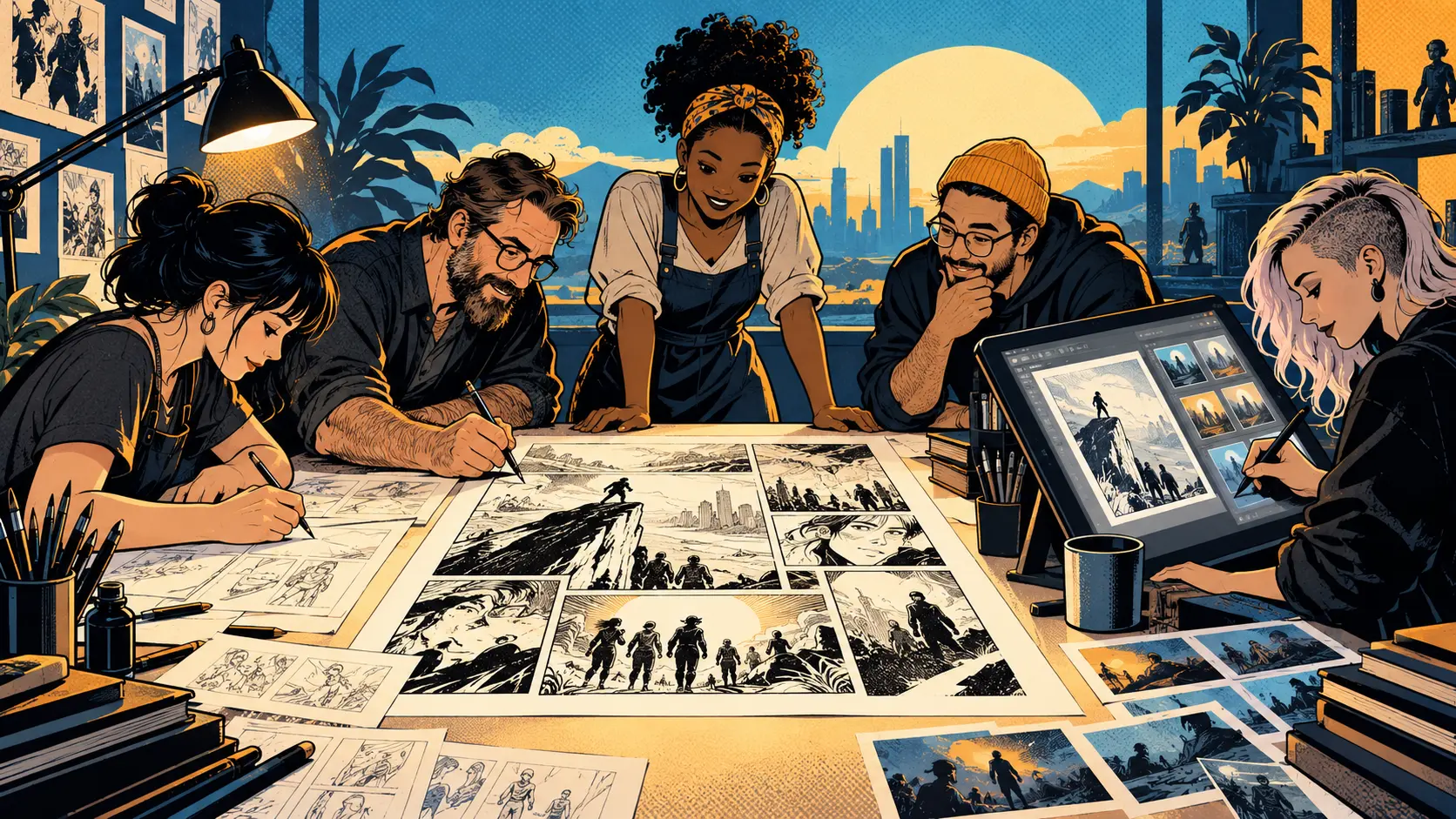
Some artists translate imagination directly through pencil, ink, paint, or digital illustration. Others work through photography, collage, 3D tools, accessibility technology, generative systems, or combinations of these methods.
Our purpose is not to replace traditional artists or erase the value of draftsmanship. It is to expand who can participate in visual storytelling while remaining honest about how each work was produced.
The disciplines are different. Both can carry meaningful human authorship when the creator makes the decisions and accepts responsibility for the result.
Respect the craft. Expand the canvas. Include the creator.
A finished comic must be directed, reviewed, corrected, and owned as a creative decision by people.
Human-created concepts, stories, characters, themes, and visual direction.
Clear credits and disclosure when generative tools materially contribute.
Every panel reviewed for anatomy, continuity, lettering, composition, and print quality.
The publisher remains responsible for originality, commercial safety, and the finished work.
New production tools do not remove the need for human intention, direction, selection, revision, and responsibility.
Computer-generated imagery changed how films could be made without making the director, production designer, animator, editor, or storyteller irrelevant.
Generative production also depends on human creative control, but its different capabilities and history demand particularly clear standards.
CGI did not eliminate filmmaking—it expanded its visual vocabulary. Responsible AI assistance can expand visual storytelling without pretending that every creative process is identical.
AI and CGI are not identical disciplines. Training data, consent, labor displacement, and the degree of automation are legitimate concerns. A credible campaign acknowledges those differences and answers them with transparency, originality, human control, and accountability.
We do not blur the difference between illustration and generative production. We name the human roles and disclose the tools.
This publication contains visuals developed with generative tools under human creative direction. The concept, story, characters, continuity, scripts, visual specifications, selection, editing, corrections, page composition, lettering, and final assembly were created and controlled by the credited human creators.
This campaign welcomes scrutiny. Clear standards are stronger than vague claims.
No. They are different disciplines. We respect traditional draftsmanship while recognizing writing, directing, continuity, editing, compositing, lettering, and visual production as legitimate creative labor.
We will not claim hand drawing when generative imagery is materially present. Each publication carries clear production credits and disclosure.
That is not our position. We support multiple production paths and leave room for paid collaboration with illustrators, inkers, colorists, cover artists, designers, editors, and letterers.
It can help a creator with strong stories and visual direction overcome barriers of drawing skill, mobility, training, time, or production cost and bring otherwise unrealized work to readers.
We use original characters and continuity, avoid unauthorized brands and characters, document our workflow, review every panel, and correct generated defects before publication.
Meaningful human creative control and responsibility: who created the purpose, made the decisions, transformed the material, and approved the finished publication.
Traditional artists deserve admiration, protection, credit, and fair compensation. Creators using responsible assistive tools deserve an honest path to publication. We can defend both.
See the stories this path makes possible